
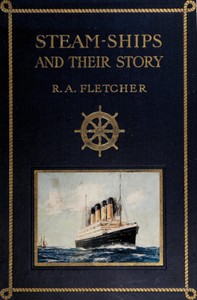
Steam-ships : The story of their development to the present day by R. A. Fletcher

(4 User reviews)   937
Fletcher, R. A. Fletcher, R. A.
English
Ever wondered how we went from wooden sailing ships to massive floating cities powered by steam? I just finished a book that answers exactly that, and it's way more exciting than it sounds. R.A. Fletcher's 'Steam-ships' isn't just a dry history; it's the story of a technological revolution that shrank the world. It follows the inventors, engineers, and dreamers who battled skeptics, dangerous boilers, and the vast, unforgiving ocean itself. If you've ever looked at a cruise ship or a container vessel and thought, 'How did we even get here?' this book is your backstage pass to the incredible drama of making that happen.
Share

Read "Steam-ships : The story of their development to the present day by R. A. Fletcher" Online

This book is available in the public domain. Start reading the digital edition below.

START READING FULL BOOK
Instant Access    Mobile Friendly

Book Preview

A short preview of the book’s content is shown below to give you an idea of its style and themes.

transcribed between _underscores_ and =equal signs= respectively. Small capitals have been converted to ALL CAPITALS. ^e represents a superscript e. [T], [U] and [V] represent T-, U- and V-shaped symbols rather than the actual letters. More Transcriber’s Notes may be found at the end of this text. STEAM-SHIPS _UNIFORM WITH THIS VOLUME_ SAILING SHIPS: THE STORY OF THEIR DEVELOPMENT FROM THE EARLIEST TIMES TO THE PRESENT DAY BY E. KEBLE CHATTERTON With a Coloured Frontispiece by CHARLES DIXON and over 130 Illustrations from Original Sources, Photographs, Models, &c. _Extra Royal 8vo, 384 pages, in Designed Cover, Cloth Gilt, 16s. net_ [Illustration: THE “WILLIAM FAWCETT,” THE FIRST P. & O. STEAM-SHIP, 209 TONS, BUILT 1829. ON THE LEFT IS A BOMB KETCH, A TYPE WITHDRAWN FROM THE NAVY ABOUT THIS DATE. ON THE RIGHT IS H. M. S. “ST. VINCENT,” 101 GUNS. _From a Painting by Charles Dixon_ _By kind permission of the Peninsular & Oriental Steam Navigation Co._] STEAM-SHIPS THE STORY OF THEIR DEVELOPMENT TO THE PRESENT DAY BY R. A. FLETCHER WITH A HUNDRED AND FIFTY ILLUSTRATIONS [Illustration] LONDON SIDGWICK & JACKSON, LTD. 3 ADAM STREET, ADELPHI, W.C. 1910 _All rights reserved_ [Illustration: PREFACE] The story of the Steam-ship, and of its development up to the present time, covers little more than a hundred years. In the companion volume,[1] the evolution of the sailing ship necessitated a comprehensive survey of some eight centuries; but that we need vessels, not only faster than the sailing ship, but also more independent of the weather conditions, is shown by the fact that in the world’s shipping tonnage of to-day (omitting small vessels) the proportion of steam to sail is as nine to one. The “seven seas” must be crossed with speed and safety, in the interest of all nations that have a mile of sea coast; but the Anglo-Saxon race, as it has contributed--from either side of the Atlantic--most largely to the mechanical and structural development of the steam-ship, now depends most vitally upon the organisation of its naval and transportation systems. Napoleon said that the strength of an army lay in its feet; no less true is it that the strength of our Empire lies in her ships. [1] “Sailing Ships and their Story,” by E. Keble Chatterton, 1909. A hundred years ago it was impossible to forecast with any accuracy how long a journey might take to accomplish, and the traveller by land or sea was liable to “moving accidents by flood and field”; but side by side with the growth of the steam-ship, and the accompanying increase of certainty in the times of departure and arrival, came the introduction of the railway system inland. Between the two, however, there is the fundamental difference that the sea is a highway open to all, while the land must be bought or hired of its owners; and the result of this was that inland transportation, implying a huge initial outlay on railroad construction, became the business of wealthy companies, whereas any man was free to build a steamboat and ply it where he would. The shipowner, moreover, has a further advantage in his freedom to choose his route, because he is at liberty to “follow trade”; but if, as has happened before now, the traffic of a town decreases, owing to a change in, or the disappearance of, its manufactures, the railway that serves it becomes proportionately useless. In another essential, the development of steam-transport on land and sea provides a more striking contrast. The main features of George Stephenson’s “Rocket” showed in 1830, in however crude a form as regards detail...

This is a limited preview. Download the book to read the full content.

Forget the dusty history section for a minute. R.A. Fletcher's 'Steam-ships' reads like the origin story of our modern, connected world. It starts with the first sputtering, unreliable paddle wheels and takes us on a journey through a century of explosive innovation.

The Story

The book isn't about a single voyage, but the grand voyage of an idea. Fletcher tracks the steam engine's move from land to sea, introducing us to the brilliant and stubborn people who made it work. We see the early, risky races across the Atlantic, the shift from paddle wheels to propellers, and the relentless push for bigger, faster, and safer ships. It's a story of constant problem-solving, set against the backdrop of global trade and travel.

Why You Should Read It

What hooked me was the human element. This isn't just a list of ship names and dates. It's about the tension between sail and steam, the public's fear of boiler explosions, and the sheer ambition to conquer distance. Fletcher makes you feel the excitement and the peril of each new breakthrough. You realize that every modern convenience we take for granted—from fresh fruit in winter to quick transatlantic travel—has roots in this story.

Final Verdict

Perfect for anyone with a curiosity about how things came to be. If you like stories of invention, enjoy historical nonfiction that moves at a good clip, or simply love the sea, you'll find this fascinating. It's a clear, engaging look at a piece of technology that truly changed everything.


📢 Legacy Content

This is a copyright-free edition. It is available for public use and education.

Michelle Nguyen
1 month ago

Reading this felt refreshing because the diagrams and footnotes included in this version are very helpful. A solid resource I will return to often.

Ethan Taylor
4 months ago

I had low expectations initially, however the technical accuracy of the content is spot on. A solid resource I will return to often.

Brian Carter
1 month ago

My professor recommended this and the interplay between the protagonists drives the story forward beautifully. It is definitely a 5-star read from me.

Karen Allen
5 months ago

Having read this twice, the writing style is poetic but not overly flowery. This turned out to be a great decision.


4
4 out of 5 (4 User reviews )

Add a Review

Your Rating *
There are no comments for this eBook.
You must log in to post a comment.
Log in

Related eBooks