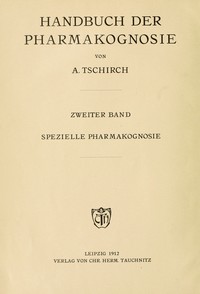
Handbuch der Pharmakognosie : Zweiter Band. Spezielle Pharmakognosie by Tschirch

(4 User reviews)   632
Tschirch, A. (Alexander), 1856-1939 Tschirch, A. (Alexander), 1856-1939
German
Okay, hear me out. I know the title sounds like something you’d find gathering dust in a university archive, but this book is a hidden treasure. It’s basically a massive, century-old field guide to the secret lives of plants. Forget modern medicine cabinets; this is about the raw ingredients. It’s a journey into a world where willow bark was your aspirin and poppy sap your painkiller. The 'conflict' here isn't between characters, but between our modern, synthetic world and the ancient, complex one of botanical medicine. It’s a fascinating look at the very roots of the drugs we take for granted today. If you've ever wondered where our medicines truly come from, this is the original map.
Share

Read "Handbuch der Pharmakognosie : Zweiter Band. Spezielle Pharmakognosie by Tschirch" Online

This book is available in the public domain. Start reading the digital edition below.

START READING FULL BOOK
Instant Access    Mobile Friendly

Book Preview

A short preview of the book’s content is shown below to give you an idea of its style and themes.

Handelswaren, sowie Personen- und Ortsnamen sind nicht einheitlich. Das Original wurde in Frakturschrift gesetzt; besondere Schriftschnitte werden im vorliegenden Text mit Hilfe der folgenden Sonderzeichen gekennzeichnet: kursiv: _Unterstriche_ fett: =Gleichheitszeichen= gesperrt: +Pluszeichen+ Kapitälchen: ~Tilden~ Das Caret-Symbol (^) steht für ein nachfolgendes hochgestelltes Zeichen. Tiefgestellte Zeichen werden in geschweifte Klammern gesetzt; zusätzlich wird noch ein Unterstrich vorangestellt, wie z.B. bei der Angabe des spezifischen Drehwinkels [α]_{D}. #################################################################### HANDBUCH DER PHARMAKOGNOSIE VON A. TSCHIRCH ZWEITER BAND SPEZIELLE PHARMAKOGNOSIE [Illustration] LEIPZIG 1912 VERLAG VON CHR. HERM. TAUCHNITZ HANDBUCH DER PHARMAKOGNOSIE VON A. TSCHIRCH ERSTE ABTEILUNG MIT 237 ABBILDUNGEN IM TEXT UND AUF EINGEHEFTETEN TAFELN, SOWIE 3 KARTEN [Illustration] LEIPZIG 1912 VERLAG VON CHR. HERM. TAUCHNITZ Das Recht der Übersetzung in fremde Sprachen ist vorbehalten DIE VERLAGSHANDLUNG Inhaltsübersicht zur ersten Abteilung des zweiten Bandes. Seite Einleitung 3 I. =Kohlehydratdrogen= (A bis D umfassen die Süßstoffdrogen) 6 A. +Drogen, die einen Zucker oder einen verwandten Süßstoff mit sechs Kohlenstoffatomen enthalten.+ a) Drogen, die Hexosen als Monosaccharide enthalten 6 Invertzuckerdrogen. Drogen, welche vorwiegend aus Invertzucker bestehen oder viel Invertzucker enthalten 8 α) _Mel_ 8 β) Blüten _Flos Verbasci_ 15 _Bassiablüten_ 23 γ) Früchte und Fruchtstände _Caricae_ 24 _Dactyli_ 35 _Passulae_ 39 δ) Zu Roobs oder Pulpen verarbeitete Früchte 43 _Fruct. Juniperi_ 44 _Fruct. Sambuci_ 53 _Fruct. Pruni_ 57 _Fruct. Jujubae_ 60 _Sebesten_ 61 _Fruct. Myrtilli_ 62 ε) Frische, zu Sirupen verarbeitete Früchte. _Fruct. Rubi idaei_ 65 _Fruct. Rubi fruticosi_ 70 _Fruct. Cerasi acidi_ 71 _Fruct. Mori_ 74 b) Drogen, die Sorbit enthalten 76 c) Drogen, die Glukuronsäure enthalten 76 _Rad. Liquiritiae_ 77 _Succus Liquiritiae_ 93 d) Drogen, welche Mannit enthalten. 1. _Eschenmanna_ 103 2. _Australisches Manna_ 113 3. _Platanus-Manna_ 113 4. _Manna von den Capverdischen Inseln_ 113 5. _Harlálumanna_ 113 6. _Olivenhonig_ 113 e) Drogen, welche Dulcit enthalten 113 _Madagaskar-Manna_ 114 B. +Drogen, welche Disaccharide von Hexosen enthalten+ 114 1. Rohrzuckergruppe. I. Drogen, welche aus Rohrzucker bestehen. Saccharum I. _Rohrzucker aus Zuckerrohr_ 117 II. _Rübenzucker_ 122 III. _Ahornzucker_ 126 IV. _Palmzucker_ 128 V. _Sorghumzucker_ 129 VI. _Andere Rohrzucker liefernde Materialien_ 130 II. Rohrzucker enthaltende Mannaarten. a) _Alhagi-Manna oder Terendschabin_ 131 b) _Tabaschir_ 132 c) _Californisches Manna_ 133 d) _Blue Grass Manna_ 133 e) _Weidenmanna oder Bide Khecht_ 133 f) _Eichenmanna oder Gueze-elefi_ 133 g) _Schîr-Khist_ 134 h) _Tamarixmanna_ 135 III. Rohrzuckerfrüchte. _Fructus Ceratoniae_ 136 2. Trehalosegruppe. _Trehalamanna_ 147 3. Milchzuckergruppe. _Milchzucker_ 148 C. +Drogen, welche Trisaccharide enthalten.+ a) _Eucalyptus-Manna_ 151 b) _Lärchen-Manna_ 151 D. +Drogen, welche Tetrasaccharide enthalten+ 152 E. +Polysacchariddrogen+ (keine Süßstoffdrogen, I-VII Inhaltsbestandteile, VIII Membranine). α) Zellinhaltsbestandteile. I. Stärkegruppe. I. Stärke aus unterirdischen Organen. a) _Amylum solani_ 158 b) Arrowroots 165 1. _Westindisches Arrowroot_ 166 2. _Maniok_ 171 3. _Ostindisches Arrowroot_ 174 4. _Queensland Arrowroot_ 175 5. _Tahiti Arrowroot_ 176 6. _Guyana Arrowroot_ (und _Bananenstärke_) 176 7. _Batatenstärke_ 177 8. _Arumstärke_ 178 9. _Costarica Arrowroot_ 178 10. _Japanisches Arrowroot_ 178 II. Stärke aus Stämmen. 1. _Sago_ 178 2. _Andere Palmen-_ (und _Cycadeen-_)_Stärke_ 184 III. Stärke aus dem Endosperm von Samen. 1. _Amylum Tritici_ 184 2. _Amylum Oryzae_ 189 3. _Amylum Maidis_ 194 4. _Fructus Hordei_ 197 IV. Stärke aus den Cotyledonen von Samen. _Leguminosenstärke_ 198 II. Amylodextringruppe 198 _Macis_ 199 III. Dextringruppe _Dextrin_ 200 IV. Inulindrogen 201 Kompositenwurzeln 202 _Rad. Cichorei_ (Cichorienkaffee) 202 _Rad. Taraxaci_ 207 _Rad. Bardanae_ 216 V. Lävulindrogen 218 VI. Triticindrogen 218 _Rhiz. Graminis_ 218 VII. Scillin-(Sinistrin-)Drogen 224 β) Membraninbildende Substanzen. VIII. Polysaccharide vom Charakter der Membranine. Membranin-Drogen 224 A. Zellulosindrogen 226 1. Celluloso-Membranin-Drogen 227 _Gossypium_ 229 _Pili haemostatici_ 246 Die Fasern 250 +Von Haaren gebildet+: _Baumwolle_, _Pflanzendunen_, _Pflanzenseiden_, _Einheimische Wollhaare_ 253 +Pflanzliche Bastfasern+: 253 _Lein_, _Hanf_, _Sunn_, _Nessel_, _Chinagras_, _Jute_, _Gambohanf_, _Neuseeländ. Flachs_, _Manilahanf_, _Pitafaser_, _Aloëhanf_, _Coir_ 254 _Papier_ 256...

This is a limited preview. Download the book to read the full content.

Let's be clear: this isn't a novel. Handbuch der Pharmakognosie is the second volume of a foundational scientific work by Alexander Tschirch, published in the early 1900s. Think of it as an incredibly detailed encyclopedia, but for plant-based drugs. This volume gets specific. It systematically catalogs and describes medicinal plants, their useful parts (roots, bark, leaves, resins), and the active compounds they contain. It’s a snapshot of pharmaceutical science at a pivotal time, documenting the natural sources of everything from caffeine and morphine to essential oils and dyes.

Why You Should Read It

Reading this feels like time travel. You’re not getting a dry list of facts; you’re peeking over the shoulder of a pioneer. Tschirch’s work bridges folk medicine and modern chemistry. It shows the sheer effort it took to understand why a certain tea worked for a fever or a specific poultice helped a wound. The meticulous descriptions remind you that every pill on a pharmacy shelf has a deep, organic history. It’s humbling and awe-inspiring to see this vast knowledge laid out before synthetic labs took over.

Final Verdict

This book isn't for everyone. It’s a specialized, historical text. But if you’re a plant nerd, a history of science enthusiast, an herbalism student curious about the academic roots of the field, or a writer looking for authentic period detail about old-world apothecaries, this is a goldmine. It’s a challenging but profoundly rewarding read for anyone fascinated by where things—especially our health—come from.


📢 Community Domain

This historical work is free of copyright protections. Feel free to use it for personal or commercial purposes.

Donald Thompson
3 months ago

I have to admit, the author's voice is distinct, making the complex topics easy to digest. I learned so much from this.

Barbara Rivera
3 weeks ago

A fantastic discovery, the author anticipates common questions and addresses them well. Highly recommended for everyone.

Nancy Williams
4 months ago

During my studies, I found that the arguments are well-supported by credible references. A true masterpiece of its kind.

Anthony Jackson
2 months ago

After years of reading similar books, the structure allows easy navigation and quick referencing. This sets a high standard for similar books.
4.5
4.5 out of 5 (4 User reviews )

Add a Review

Your Rating *
There are no comments for this eBook.
You must log in to post a comment.
Log in

Related eBooks