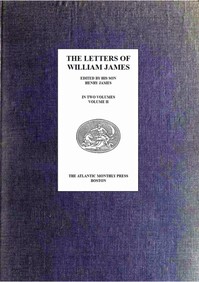
The Letters of William James, Vol. 2 by William James

(4 User reviews)   660
James, William, 1842-1910 James, William, 1842-1910
English
Ever wonder what it was like to be at the very heart of American intellectual life during one of its most exciting periods? This isn't a dry biography. This is William James, the father of American psychology and philosophy, in his own words. Volume 2 of his letters covers the 1880s and 1890s—a time when he was building his career, battling crippling depression, and wrestling with the biggest ideas of his age. It’s like getting a backstage pass to his mind. You see him not as a distant figure, but as a brilliant, funny, and deeply human friend trying to figure it all out, just like the rest of us.
Share

Read "The Letters of William James, Vol. 2 by William James" Online

This book is available in the public domain. Start reading the digital edition below.

START READING FULL BOOK
Instant Access    Mobile Friendly

Book Preview

A short preview of the book’s content is shown below to give you an idea of its style and themes.

laboratory had already been placed under Professor Münsterberg's charge. For one year, during which Münsterberg returned to Germany, James was compelled to direct its conduct; but he let it be known that he would resign his professorship rather than concern himself with it indefinitely. Readers of this book will have seen that the centre of his interest had always been religious and philosophical. To be sure, the currents by which science was being carried forward during the sixties and seventies had supported him in his distrust of conclusions based largely on introspection and _a priori_ reasoning. As early as 1865 he had said, apropos of Agassiz, "No one sees farther into a generalization than his own knowledge of details extends." In the spirit of that remark he had spent years on brain-physiology, on the theory of the emotions, on the feeling of effort in mental processes, in studying the measurements and exact experiments by means of which the science of the mind was being brought into quickening relation with the physical and biological sciences. But all the while he had been driven on by a curiosity that embraced ulterior problems. In half of the field of his consciousness questions had been stirring which now held his attention completely. Does consciousness really exist? Could a radically empirical conception of the universe be formulated? What is knowledge? What truth? Where is freedom? and where is there room for faith? Metaphysical problems haunted his mind; discussions that ran in strictly psychological channels bored him. He called psychology "a nasty little subject," according to Professor Palmer, and added, "all one cares to know lies outside." He would not consider spending time on a revised edition of his textbook (the "Briefer Course") except for a bribe that was too great ever to be urged upon him. As time went on, he became more and more irritated at being addressed or referred to as a "psychologist." In June, 1903, when he became aware that Harvard was intending to confer an honorary degree on him, he went about for days before Commencement in a half-serious state of dread lest, at the fatal moment, he should hear President Eliot's voice naming him "Psychologist, psychical researcher, willer-to-believe, religious experiencer." He could not say whether the impossible last epithets would be less to his taste than "psychologist." Only along the borderland between normal and pathological mental states, and particularly in the region of "religious experience," did he continue to collect psychological data and to explore them. The new subjects which he offered at Harvard during the nineties are indicative of the directions in which his mind was moving. In the first winter after his return he gave a course on Cosmology, which he had never taught before and which he described in the department announcement as "a study of the fundamental conceptions of natural science with especial reference to the theories of evolution and materialism," and for the first time announced that his graduate "seminar" would be wholly devoted to questions in mental pathology "embracing a review of the principal forms of abnormal or exceptional mental life." In 1895 the second half of his psychological seminar was announced as "a discussion of certain theoretic problems, as Consciousness, Knowledge, Self, the relations of Mind and Body." In 1896 he offered a course on the philosophy of Kant for the first time. In 1898 the announcement of his "elective" on Metaphysics explained that the class would consider "the unity or pluralism of the world ground, and its knowability or unknowability; realism and idealism, freedom, teleology and theism."[2] But there is another aspect...

This is a limited preview. Download the book to read the full content.

Forget the formal portrait. 'The Letters of William James, Vol. 2' gives you the man behind the ideas. This collection covers a crucial two decades, from the 1880s to the early 1900s. We follow James as he moves from a struggling young professor to an established giant at Harvard. But the real story isn't just about success. It's about the struggle that happened alongside it.

The Story

There isn't a traditional plot. Instead, you get a front-row seat to a life being lived. You'll read letters to his famous brother, the novelist Henry James, to friends, colleagues, and students. You'll see him develop his groundbreaking ideas on psychology and pragmatism in real time. More importantly, you'll see him grapple with 'the blues'—his term for the profound depression that haunted him. The book shows how his personal battles with meaning and despair directly fueled his philosophical search for a practical, life-affirming way to live.

Why You Should Read It

I picked this up thinking I'd get some intellectual history. What I got was a surprisingly intimate and encouraging companion. James writes with incredible warmth and wit. His advice to students is timeless, his doubts are relatable, and his joy in simple things is contagious. Reading his letters, you understand that his philosophy wasn't just an academic exercise; it was a survival tool, forged in the fire of his own experience. It makes his ideas on will, belief, and habit feel incredibly personal and powerful.

Final Verdict

Perfect for anyone curious about the human side of great thinkers, or for readers who find philosophy intimidating. This book makes profound ideas accessible through the lens of a fascinating, flawed, and deeply sympathetic life. It’s not a quick read, but it’s a richly rewarding one—a chance to have a long, meandering, and brilliant conversation with one of America's greatest minds.


✅ Copyright Free

This work has been identified as being free of known copyright restrictions. Access is open to everyone around the world.

Ashley Green
3 months ago

After completing the first chapter, the clarity of the writing makes this accessible to a wide audience. I’ll be referencing this again soon.

Kevin Allen
5 months ago

I was skeptical at first, but the storytelling feels authentic and emotionally grounded. This made complex ideas feel approachable.

Carol Roberts
2 months ago

As part of my coursework, the content strikes a great balance between detail and readability. Simply brilliant.

Susan Nguyen
1 month ago

After looking for this everywhere, the narrative structure is incredibly compelling and well-thought-out. An impressive piece of work.

5
5 out of 5 (4 User reviews )

Add a Review

Your Rating *
There are no comments for this eBook.
You must log in to post a comment.
Log in

Related eBooks