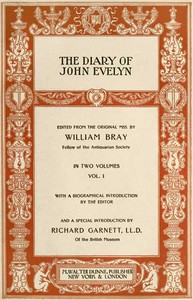
The Diary of John Evelyn (Volume 1 of 2) by John Evelyn

(5 User reviews)   807
Evelyn, John, 1620-1706 Evelyn, John, 1620-1706
English
Imagine having a front-row seat to one of the most turbulent centuries in English history—the English Civil War, the Great Plague, the Great Fire of London—all through the eyes of a man who was there, writing it all down. That's John Evelyn's diary. This isn't just a history book; it's a time machine. You get the big events, sure, but also the everyday gossip, the scientific curiosities, and the quiet worries of a man trying to live a good life while the world around him falls apart and rebuilds. It's surprisingly personal, often funny, and completely absorbing. If you think 17th-century diaries are dry, Evelyn will change your mind.
Share

Read "The Diary of John Evelyn (Volume 1 of 2) by John Evelyn" Online

This book is available in the public domain. Start reading the digital edition below.

START READING FULL BOOK
Instant Access    Mobile Friendly

Book Preview

A short preview of the book’s content is shown below to give you an idea of its style and themes.

Charles Austin served the devil, and died rich. Both were clever fellows. Charles was much the cleverer of the two." Thus John Evelyn and Samuel Pepys, the former a perfect model of decorum, the latter a grievous example of indecorum, have respectively left us diaries, of which the indecorous is to the decorous as a zoölogical garden is to a museum: while the disparity between the testamentary bequests of the two Austins but imperfectly represents the reputation standing to Pepys's account with posterity in comparison with that accruing to his sedate and dignified contemporary. Museums, nevertheless, have their uses, and Evelyn's comparatively jejune record has laid us under no small obligation. But for Pepys's amazing indiscretion and garrulity, qualities of which one cannot have too little in life, or too much in the record of it, Evelyn would have been esteemed the first diarist of his age. Unable for want of these qualifications to draw any adequate picture of the stirring life around him, he has executed at least one portrait admirably, his own. The likeness is, moreover, valuable, as there is every reason to suppose it typical, and representative of a very important class of society, the well-bred and well-conducted section of the untitled aristocracy of England. We may well believe that these men were not only the salt but the substance of their order. There was an ill-bred section exclusively devoted to festivity and sport. There was an ill-conducted section, plunged into the dissipations of court life. But the majority were men like Evelyn: not, perhaps, equally refined by culture and travel, or equally interested in literary research and scientific experiment, but well informed and polite; no strangers to the Court, yet hardly to be called courtiers, and preferring country to town; loyal to Church and King but not fanatical or rancorous; as yet but slightly imbued with the principles of civil and religious liberty, yet adverse to carry the dogma of divine right further than the right of succession; fortunate in having survived all ideas of serfdom or vassalage, and in having few private interests not fairly reconcilable with the general good. Evelyn was made to be the spokesman of such a class, and, meaning to speak only for himself, he delivers its mind concerning the Commonwealth and the Restoration, the conduct of the later Stuart Kings and the Revolution. Evelyn's Diary practically begins where many think he had no business to be diarising, beyond the seas. The position of a loyalist who solaces himself in Italy while his King is fighting for his crown certainly requires explanation: it may be sufficient apology for Evelyn that without the family estates he could be of no great service to the King, and that these, lying near London, were actually in the grasp of the Parliament. He was also but one of a large family and it was doubtless convenient that one member should be out of harm's way. His three years' absence (1643-6) has certainly proved advantageous to posterity. Evelyn is, indeed, a mere sight-seer, but this renders his tour a precise record of the objects which the sight-seer of the seventeenth century was expected to note, and a mirror not only of the taste but of the feeling of the time. There is no cult of anything, but there is curiosity about everything; there is no perception of the sentiment of a landscape, but real enjoyment of the landscape itself; antiquity is not unappreciated, but modern works impart more real pleasure. Of the philosophical reflections which afterward rose to the mind of Gibbon there is hardly a...

This is a limited preview. Download the book to read the full content.

John Evelyn started his diary as a young man in 1641 and kept it for most of his life. This first volume covers the explosive middle decades of the 1600s. We follow him as he travels through Europe to avoid England's civil war, returns home, and builds a life as a scholar, gardener, and friend to powerful people. The diary is his record of everything: the trees he planted, the sermons he heard, the experiments he saw at the new Royal Society, and the major public disasters that defined the age.

The Story

There's no single plot, but the central thread is Evelyn himself navigating a world in chaos. He witnesses the execution of King Charles I, which he calls 'a horrible and unjust murder.' He documents the Great Plague of 1665 with chilling, matter-of-fact detail about the empty streets. His famous account of the Great Fire of London in 1666 puts you right there in the smoke and panic. But it's just as much about his passion for landscape gardening, his struggles with his children, and his fascination with the first blood transfusions. It's the story of a curious mind living through extraordinary times.

Why You Should Read It

You should read it because Evelyn feels like a real person, not a statue from a history book. His voice is wonderfully clear and often opinionated. You get his frustration with loud parties next door, his pride in his pear trees, and his genuine grief during national tragedies. He connects the huge historical events to the human scale. Reading his diary makes you realize that people in the past weren't just 'historical figures'—they were individuals who worried about their families, enjoyed their hobbies, and were shocked by the news, just like us.

Final Verdict

This book is perfect for anyone who loves history but wants to move beyond kings and battles to the texture of daily life. It's for gardeners, science enthusiasts, and Londonphiles. If you enjoyed Samuel Pepys's diary, you'll meet his more reserved but equally fascinating friend here. Be prepared for a slow, rewarding read. Dip in and out. Let Evelyn be your guide to a world that is both profoundly strange and surprisingly familiar. A true masterpiece of observation.


⚖️ Copyright Free

This text is dedicated to the public domain. It is now common property for all to enjoy.

Margaret Lopez
1 month ago

Once I started reading, the diagrams and footnotes included in this version are very helpful. This turned out to be a great decision.

Donna Wilson
3 months ago

This exceeded my expectations because the content encourages further exploration of the subject. This felt rewarding to read.

Matthew Thompson
1 week ago

I approached this with an open mind and the balance between theory and practice is exceptionally well done. This has earned a permanent place in my collection.

John Carter
3 months ago

I approached this with curiosity because the organization of topics is intuitive and reader-friendly. This deserves far more attention.

Logan Mitchell
4 weeks ago

From a casual reader’s perspective, the writing style is poetic but not overly flowery. I learned so much from this.
4.5
4.5 out of 5 (5 User reviews )

Add a Review

Your Rating *
There are no comments for this eBook.
You must log in to post a comment.
Log in

Related eBooks