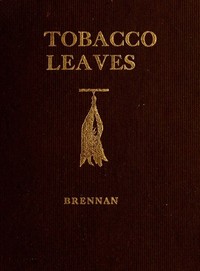
Tobacco Leaves: Being a Book of Facts for Smokers by William Augustine Brennan

(5 User reviews)   496
Brennan, William Augustine, 1867- Brennan, William Augustine, 1867-
English
Ever wonder what people really thought about smoking before we knew all the health risks? This book is a fascinating time capsule from 1905. It's not a dry history lesson—it's a collection of opinions, ads, and bizarre facts from an era when tobacco was just part of everyday life. The author, William Augustine Brennan, gathers everything from poems praising pipes to early, awkward warnings about cigarettes. Reading it feels like digging through your great-grandfather's attic and finding his secret smoking journal. The main 'mystery' is seeing how our modern view of smoking slowly started to form over a century ago. It's weird, charming, and surprisingly human.
Share

Read "Tobacco Leaves: Being a Book of Facts for Smokers by William Augustine Brennan" Online

This book is available in the public domain. Start reading the digital edition below.

START READING FULL BOOK
Instant Access    Mobile Friendly

Book Preview

A short preview of the book’s content is shown below to give you an idea of its style and themes.

without bringing us one day or one minute nearer to their close. Suppose that one could fix upon the terminal point, we would still fancy something beyond that, and then some period still more remote would present itself, and so on _ad infinitum_. The same insurmountable difficulty confronts us when we seek to imagine a First Cause. God was the beginning, and yet it seems to our finite minds, that something must have brought Him into existence, and we conclude that back again of that creating Power must have been another originating cause, and perhaps still another, and so on without limitation. And yet we know that there must have been a period when everything was void, or, in other words, when there was nothing. In the awful grandeur of that loneliness, desolation, and chaos, God we know, however, existed and called the universe into being. All that we, in our present finite condition, can ever comprehend of that stupendous birth is contained in the opening of the first chapter of Genesis. That is the story of the creation as told by God Himself to His chosen people, the Hebrews, they alone being selected from the nations then existing upon the earth to receive the wonderful revelation. Every people, no matter how degraded and sunken in barbarism, has some perception, some explanation of, and a more or less well-grounded belief in, a First Cause. Far back among the mists of antiquity, at the remotest beginnings of the shadowy centuries, sits enthroned a Being, who in His infinite might and power brought mankind, the universe, and all animate and inanimate things into existence, and who rewards those of His children who do His will, and punishes those who disobey His commands. That will, as interpreted by believers, is as various in its application to the conduct of man as are the standards of right and wrong among the civilized and even among the barbarous nations of to-day. What is virtue with one is vice with the other, as beauty and ugliness of form or feature, being relative terms, are opposites with many different peoples. Since the Greeks and Romans were not among those who received the divine story of creation, they were forced to devise a theory to explain their own existence and account for the origin of all things. The foundation of this theory lay in the marvelous phenomena of nature around them. The growth of the mighty tree from the tiny seed, the bursting bud and blossom, the changing hues and the fragrance of flowers, the alternation of day and night, the flash of the rock-rending lightning, the rage of the tempest, the flow of the rivers; the towering mountains, the lovely valleys; dew, rain, the clouds, and the ever-shifting panorama on every hand; the majestic sweep of the blazing worlds through space--all these pointed unerringly to a First Cause, which originally launched them into being, and maintains the constant order of things and the miraculous procession of the planets and the orderly succession of the seasons in obedience to laws that know no change. To the Greeks and Romans, there was a time more remote than history gives us any account of, when there was neither land nor water, and when the earth and all things within and upon it were "without form and void." Over that misty, nebulous mixing and mingling brooded the god Chaos, who shared his throne with Nox, the goddess of night. From this union the innumerable myths gradually sprang up and developed, which in their own imaginative though often grotesque way explained the...

This is a limited preview. Download the book to read the full content.

Forget what you know about tobacco. This isn't a modern health guide or a moral lecture. Published in 1905, Tobacco Leaves is a snapshot of a world where smoking was just... normal. Author William Augustine Brennan acts more as a curator than a writer. He pulls together quotes from famous authors, reproduces old cigarette advertisements (some are hilariously earnest), shares poems, and even includes some of the earliest public murmurs of concern about the habit.

The Story

There isn't a plot in the traditional sense. Think of it as a scrapbook. One page might have a solemn quote from a doctor warning about 'cigarette heart,' and the next page is a colorful ad claiming a certain brand 'aids digestion.' Brennan doesn't push one narrative. Instead, he lays out the conversation—the love, the lore, and the very first doubts—allowing you to see the cultural moment for yourself. It's the full, unfiltered social history of smoking before the big health revelations of the 20th century.

Why You Should Read It

I loved this book because it doesn't judge. It simply presents a past mindset. You get the cozy, romantic side—the poets writing odes to a good cigar—right alongside the early, confused science. It makes you realize how cultural attitudes are built and how they can change. The most compelling parts are those early warnings; reading them with today's knowledge gives you a real chill. It's a powerful reminder that 'common knowledge' isn't always common, or even knowledge, until it is.

Final Verdict

This is a niche gem, but a brilliant one. It's perfect for history buffs who want to feel a time period, not just read about dates. Sociologists and marketing folks would also find it a goldmine. If you enjoy primary sources and seeing how everyday life looked through the eyes of people living it, you'll be captivated. Just don't expect a novel. Expect a conversation with the past.


🏛️ License Information

This work has been identified as being free of known copyright restrictions. Thank you for supporting open literature.

Donald Nelson
3 weeks ago

I went into this with no expectations and the depth of research presented here is truly commendable. I’d rate this higher if I could.

Patricia Ramirez
2 months ago

From start to finish, the diagrams and footnotes included in this version are very helpful. A valuable addition to my digital library.

Michelle Campbell
3 months ago

I found this while browsing online and the explanations are structured in a clear and logical manner. I'm sending the link to all my friends.

Kenneth Hill
1 month ago

It’s rare that I write reviews, but the author anticipates common questins and addresses them well. A true masterpiece of its kind.

Deborah Garcia
2 months ago

From a technical persepctive, the clarity of explanations makes revisiting sections worthwhile. An impressive piece of work.


4
4 out of 5 (5 User reviews )

Add a Review

Your Rating *
There are no comments for this eBook.
You must log in to post a comment.
Log in

Related eBooks