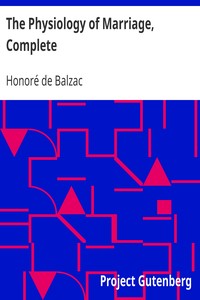
The Physiology of Marriage, Complete by Honoré de Balzac

(4 User reviews)   742
Balzac, Honoré de, 1799-1850 Balzac, Honoré de, 1799-1850
English
Hey, I just finished this wild book from 1829 called 'The Physiology of Marriage.' Don't let the title fool you—it's not a dry science text. It's Balzac, the famous French novelist, writing a bizarre, satirical 'manual' on how a husband can prevent his wife from having an affair. Think of it as a darkly comic survival guide from a time when marriage was a battlefield and women had very few legal rights. It's shocking, often offensive to modern sensibilities, and completely fascinating as a historical artifact. It reads like a deeply cynical stand-up routine about the war between the sexes in 19th-century Paris.
Share

Read "The Physiology of Marriage, Complete by Honoré de Balzac" Online

This book is available in the public domain. Start reading the digital edition below.

START READING FULL BOOK
Instant Access    Mobile Friendly

Book Preview

A short preview of the book’s content is shown below to give you an idea of its style and themes.

growths of nature. Laws are made to suit manners, and manners vary. “Marriage must therefore undergo the gradual development towards perfection to which all human affairs submit.” These words, pronounced in the presence of the Conseil d’Etat by Napoleon during the discussion of the civil code, produced a profound impression upon the author of this book; and perhaps unconsciously he received the suggestion of this work, which he now presents to the public. And indeed at the period during which, while still in his youth, he studied French law, the word ADULTERY made a singular impression upon him. Taking, as it did, a prominent place in the code, this word never occurred to his mind without conjuring up its mournful train of consequences. Tears, shame, hatred, terror, secret crime, bloody wars, families without a head, and social misery rose like a sudden line of phantoms before him when he read the solemn word ADULTERY! Later on, when he became acquainted with the most cultivated circles of society, the author perceived that the rigor of marriage laws was very generally modified by adultery. He found that the number of unhappy homes was larger than that of happy marriages. In fact, he was the first to notice that of all human sciences that which relates to marriage was the least progressive. But this was the observation of a young man; and with him, as with so many others, this thought, like a pebble flung into the bosom of a lake, was lost in the abyss of his tumultuous thoughts. Nevertheless, in spite of himself the author was compelled to investigate, and eventually there was gathered within his mind, little by little, a swarm of conclusions, more or less just, on the subject of married life. Works like the present one are formed in the mind of the author with as much mystery as that with which truffles grow on the scented plains of Perigord. Out of the primitive and holy horror which adultery caused him and the investigation which he had thoughtlessly made, there was born one morning a trifling thought in which his ideas were formulated. This thought was really a satire upon marriage. It was as follows: A husband and wife found themselves in love with each other for the first time after twenty-seven years of marriage. He amused himself with this little axiom and passed a whole week in delight, grouping around this harmless epigram the crowd of ideas which came to him unconsciously and which he was astonished to find that he possessed. His humorous mood yielded at last to the claims of serious investigation. Willing as he was to take a hint, the author returned to his habitual idleness. Nevertheless, this slight germ of science and of joke grew to perfection, unfostered, in the fields of thought. Each phase of the work which had been condemned by others took root and gathered strength, surviving like the slight branch of a tree which, flung upon the sand by a winter’s storm, finds itself covered at morning with white and fantastic icicles, produced by the caprices of nightly frosts. So the sketch lived on and became the starting point of myriad branching moralizations. It was like a polypus which multiplies itself by generation. The feelings of youth, the observations which a favorable opportunity led him to make, were verified in the most trifling events of his after life. Soon this mass of ideas became harmonized, took life, seemed, as it were, to become a living individual and moved in the midst of those domains of fancy, where the soul...

This is a limited preview. Download the book to read the full content.

First things first: this is not a novel. It's a strange, essay-like work where Balzac pretends to be a serious 'scientist' of marriage. He breaks the subject down into theories, observations, and strategies, all focused on one goal—helping a husband maintain control and avoid being cuckolded.

The Story

There's no traditional plot with characters. Instead, Balzac creates a fictional 'author' who lays out a systematic, often absurd, plan for marital management. He categorizes wives into types, analyzes the 'enemies' of marriage (like the charming bachelor next door), and proposes tactics ranging from surveillance and controlling the household finances to manipulating a wife's emotions. The entire book is framed as a defensive operation, with the home as a fortress under constant threat.

Why You Should Read It

It's a jaw-dropping look into the past. The value isn't in agreeing with Balzac (you almost certainly won't), but in seeing the raw, unvarnished anxieties of his time. The book is a mix of piercing social observation and shocking prejudice. You'll gasp at some passages and laugh at the sheer audacity of others. It reveals how marriage was viewed as a power structure long before it was widely seen as a partnership. Reading it feels like uncovering a secret, deeply cynical rulebook from a different world.

Final Verdict

This is for readers who love historical context, social satire, and aren't afraid of problematic older texts. It's perfect for anyone interested in the history of gender relations, fans of Balzac who want to see his non-fiction voice, or people who enjoy books that are more 'interesting' than 'likeable.' Don't read it for relationship advice—read it as a compelling, uncomfortable, and darkly funny piece of social history.


📢 Public Domain Content

There are no legal restrictions on this material. It serves as a testament to our shared literary heritage.

Noah Taylor
3 months ago

Out of sheer curiosity, the diagrams and footnotes included in this version are very helpful. A solid resource I will return to often.

William Allen
2 months ago

During my studies, I found that the interplay between the protagonists drives the story forward beautifully. It was exactly what I needed right now.

Richard Allen
1 month ago

This exceeded my expectations because the character development is subtle yet leaves a lasting impact. Thanks for making this available.

Aiden Lopez
1 month ago

Simply put, the insights offered are both practical and thought-provoking. This book will stay with me for a longg time.

4.5
4.5 out of 5 (4 User reviews )

Add a Review

Your Rating *
There are no comments for this eBook.
You must log in to post a comment.
Log in

Related eBooks