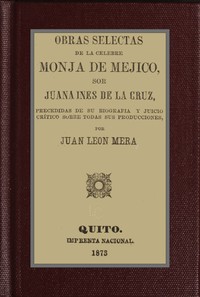
Obras selectas de la celebre monja de Mejico, sor Juana Ines de la Cruz…

(5 User reviews)   1094
Juana Inés de la Cruz, Sister, 1651-1695 Juana Inés de la Cruz, Sister, 1651-1695
Spanish
Ever wonder what it was like to be the smartest person in the room in 17th-century Mexico, when that room was a convent and you were a woman? That's the life of Sor Juana Inés de la Cruz. This collection isn't just old poetry; it's the voice of a nun who argued for women's right to education with a sharper wit than most scholars of her time. She wrote passionate love poems to God, biting satire about foolish men, and brilliant arguments that got her in serious trouble with the church authorities. Reading her feels like uncovering a secret history of a feminist mind trapped in a gilded cage. She’s been called the first great poet of the Americas, and once you read her, you’ll understand why.
Share

Read "Obras selectas de la celebre monja de Mejico, sor Juana Ines de la Cruz…" Online

This book is available in the public domain. Start reading the digital edition below.

START READING FULL BOOK
Instant Access    Mobile Friendly

Book Preview

A short preview of the book’s content is shown below to give you an idea of its style and themes.

nivelado con el del hombre, su _compañero_, no su _señor_ y _dueño_. Prescindamos, pues, de una erudicion intempestiva, y limitémonos á breves reminiscencias cuando vengan ajustadas al agradable tema en que vamos á ocuparnos: la vida de una célebre mujer y las obras con que inmortalizó su nombre y honró á su patria. II El siglo que dió á la literatura francesa las Sevigné y las Dacier, dió también á la española las Záyas de Sotomayor en la península y las Sor Juana Ines de la Cruz en América. ¿Quién fué esta religiosa? Sabíamos que hácia los últimos años del siglo XVII habia florecido en la tierra de Anahuac un notable ingenio poético llamado de aquel nombre. Pero á esto solo se hallaban circunscritas nuestras noticias: conocíamos, pues, un nombre; esto es, no conocíamos nada. ¿Quién puede preciarse de saber el contenido de un libro porque aprendió su título de memoria? Con todo, un nombre de mujer, y de mujer americana, fué motivo bastante poderoso para dispertar nuestras simpatías por ella, y hacernos desear el conocimiento de sus obras. Por aquel tiempo leimos la excelente “Historia de la literatura española” por M. Ticknor, y encontramos mentado el nombre de la monja de Méjico precedido del epíteto de _célebre_. En una nota, al pié de la página, se la llama la _Décima Musa_ y se citan sus _poemas_ dados á la estampa en Zaragoza de 1682 á 1725, en tres tomos en 4º; mas al fin se han puesto estas líneas tomadas del “Semanario pintoresco” del año 1845: “Sor Juana Ines de la Cruz, mas notable como mujer que como poeta, nació en Guipúzcoa[A] en 1651, y murió en Méjico en 1695.” Ser célebre y merecer el dictado de décima musa, son cosas incompatibles con el juicio fatal que encierran estas últimas palabras. Un calificativo honroso en boca de M. Ticknor es tìtulo valioso: difícilmente el concienzudo literato anglo-americano pudo haber concedido celebridad á quien no la tenia. En lo de haber levantado á la monja al coro de las piérides, no teniamos confianza, porque era obra de sus contemporáneos y, sobre todo, de un tiempo en que la hipérbole fué condicion precisa del elogio, y este se habia abaratado por estremo en el mercado de las letras castellanas. Por otra parte, juzgábamos que los autores del “Semanario pintoresco” no se habrian atrevido á echar á volar su parecer acerca de una poetisa que les pertenecia, sino con pleno conocimiento de sus obras, y fiados en muy sano criterio. Una mujer, una americana habia escrito versos á fines del siglo XVII. Esta rareza llamó acaso la atencion de M. Ticknor, mas que el mérito real de esos versos, y le hizo soltar en su “Historia de la literatura española” una palabra de tanta significacion. El que halló en la misma autora mayor mérito en la mujer que en el poeta, tuvo, pues, acaso mas razon. El sexo sirvió en cierta manera à las letras, no estas al sexo; la hechura, aunque asaz imperfecta, se hizo notable á causa de la deficiencia del instrumento en ella empleado. Ademas, las notas de la obra citada, ¿no son puestas por el mismo M. Ticknor? A tales reflexiones nos condujo nuestra sindéresis. La simpatía vacilaba, pero era mas ardiente el deseo que abrigábamos de conocer las poesías de Sor Juana Ines. El velo de la ilusion no se habia rasgado del todo, aunque presentíamos que iba á desaparecer una estrella del cielo americano, y esto nos causaba enojo. La ruptura entre nuestro primer pensamiento sobre la autora y nuestro juicio posterior, entre el afecto que...

This is a limited preview. Download the book to read the full content.

This isn't a novel with a single plot, but the story of an extraordinary life told through verse and prose. "Obras Selectas" (Selected Works) gathers the essential writings of Sor Juana, a self-taught scholar who entered a convent to pursue a life of the mind. The 'story' here is her intellectual journey: her early fame at the viceroy's court, her decision to become a nun for the freedom it offered, her massive collection of books, and her fierce defense of a woman's right to study and write. The central conflict comes to a head in her famous "Respuesta a Sor Filotea" (Reply to Sister Philotea), a stunning letter where she defends herself against a bishop who told her to stick to prayer and abandon her studies.

Why You Should Read It

You should read Sor Juana because she is shockingly modern. Her poems about love and jealousy crackle with a raw, human energy that transcends centuries. Her critiques of double standards—where men are praised for knowledge while women are scolded for it—feel like they could be written today. Reading her work, you get a real person: witty, proud, frustrated, and devoutly faithful, all at once. It’s a powerful reminder that brilliant voices have always existed, even when history tried to silence them.

Final Verdict

Perfect for readers who love historical figures that break the mold, fans of sharp poetry, and anyone interested in the roots of feminist thought. If you enjoy seeing someone use their intellect as a weapon against injustice, you'll find a kindred spirit in Sor Juana. Just be prepared—her brilliance is still dazzling over 300 years later.


⚖️ Public Domain Content

This historical work is free of copyright protections. Use this text in your own projects freely.

Sarah Roberts
5 months ago

I needed a solid reference and the explanations feel carefully crafted rather than rushed. This turned out to be a great decision.

Amanda Davis
3 months ago

As part of my coursework, the content encourages further exploration of the subject. I’ll definitely revisit this in the future.

Richard Jackson
3 months ago

I was skeptical at firsst, but the balance between theory and practice is exceptionally well done. It was exactly what I needed right now.

James Hill
4 months ago

A fantastic discovery, the insights offered are both practical and thought-provoking. This was both informative and enjoyable.

Michelle Williams
1 month ago

This download was worth it since it creates a vivid world that you simply do not want to leave. This left a lasting impression on me.

5
5 out of 5 (5 User reviews )

Add a Review

Your Rating *
There are no comments for this eBook.
You must log in to post a comment.
Log in

Related eBooks