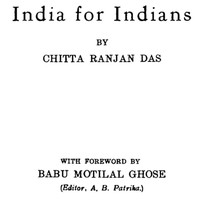
India for Indians by Chitta Ranjan Das

(5 User reviews)   583
By Charles Murphy Posted on Jan 12, 2026
In Category - Resilience
Das, Chitta Ranjan, 1870-1925 Das, Chitta Ranjan, 1870-1925
English
Ever wonder what Indians were thinking about their own future right when British rule was at its peak? Not just fighting for independence, but imagining what a free India should actually look like? That's exactly what Chitta Ranjan Das does in 'India for Indians.' Written over a century ago, this isn't a dusty history lesson. It's a bold, urgent blueprint. Das argues fiercely against just swapping one set of rulers for another. He asks the tough question: once the British leave, what kind of country will we build for ourselves? Reading it today feels like uncovering a secret conversation about India's soul that's still incredibly relevant.
Share

Read "India for Indians by Chitta Ranjan Das" Online

This book is available in the public domain. Start reading the digital edition below.

START READING FULL BOOK
Instant Access    Mobile Friendly

Book Preview

A short preview of the book’s content is shown below to give you an idea of its style and themes.

honour, with Chitta. Ranjan to share this indignity with his father. He was very seriously handicapped, both in his professional and in his public life, by this insolvency. But for it, Chitta Ranjan would have long ago publicly thrown himself into all our political and patriotic movements and won the position of leadership to which he was entitled by his capacity and his devoted love for his country. Though his exceptional abilities were universally recognised, from the very beginning of his career as a member of our High Court Bar, he could not secure adequate scope for them for a good many years; pecuniary struggles forced him to abandon the chances of a successful practice in the High Court for the mufassal practice which is more profitable to a junior Barrister. The celebrated Conspiracy Case against Srijut Aravinda Ghosh, in which he appeared as Aravinda's Counsel pushed Chitta Ranjan into the fore front of the Calcutta Bar. Great was the sacrifice that he made in undertaking this defence. For more than six months he was engaged in this case, and the fee that he received was not sufficient to meet even all his household expenses during these months; and he had to incur a large debt for this purpose. The acquittal of Aravinda at once raised the reputation of his Counsel, and from the very day that Chitta Ranjan came back to take up the broken threads of his High Court practice, he found himself on the high road to both fame and wealth. This reminds me of the saying of Sree Bhagavan in the Geeta--that the doer of good never comes to any grief. As soon as he found his position in this profession secure, Chitta Ranjan's first thought was to remove the stain of insolvency from his father's name and his own and he started to pay off every pie of those old debts. This is the first time, as Mr. Justice Fletcher declared, that a discharged insolvent publicly accepted his old liabilities and applied for a formal discharge of his insolvency. This act of unusual fidelity to his financial obligations, at once raised Chitta Ranjan Das to the position of a great moral hero. Having secured his discharge from his insolvency, Chitta Ranjan found himself free to freely and openly join all our public activities; and as the new National Life in Bengal, denied free scope and outlet in politics by the restrictive legislations of Lord Minto, had commenced to seek and find expression in a variety of literary organisations. Chitta Ranjan threw himself into this Nationalist Movement, and soon found himself among its great leaders. In 1915 he started a new Bengalee Monthly, the _Narayana_, which secured for its contributors some of the highest literateurs of Bengal, including Maha-Mahopadhyaya Hara Prasad Sastri who has an European reputation, and Babu Bepin Chandra Pal. Chitta Ranjan's entry into Bengalee literature dates from 1894 or 1895 when he published a volume of Bengalee lyrics, called _Malancha_ which introduced a new element of freedom and realism into our modern lyrical literature. During the last two years, two more volumes of Lyrics have been published by him. The last annual Literary Conference of Bengal, in recognition of his literary services, nominated Chitta Ranjan as the President of its Literary Section while the political leaders of the Province offered him an equal recognition by asking him to preside over our last Provincial Conference. The speeches collected and published in this volume are the latest pronouncements of Mr. C. R. Das upon some of the pressing political problems before us. They have already...

This is a limited preview. Download the book to read the full content.

Published in 1905, 'India for Indians' arrives at a boiling point in Indian history. The British Raj is firmly in place, but the desire for self-rule is growing louder. Chitta Ranjan Das, a key leader in the independence movement, doesn't just add his voice to the protest. Instead, he looks past the fight to what comes next.

The Story

This isn't a novel with characters, but an argument with a clear mission. Das lays out his vision for a future, independent India built on its own strengths. He critiques the colonial system not just for its oppression, but for how it warps Indian society and thought. The core of the book is his proposal for 'Swaraj' – true self-rule. For Das, this means more than political freedom; it's about economic self-reliance, reviving Indian industries and education, and fostering a national spirit that is confident and self-defined.

Why You Should Read It

What grabbed me was how modern his worries feel. He talks about the dangers of blindly copying the West and the need for India to find its own path. You can feel his passion and frustration on every page. It's like listening to a brilliant, fired-up friend explain exactly how to fix a broken system. Reading this gives you a front-row seat to the intellectual foundations of the independence struggle, straight from one of its architects.

Final Verdict

Perfect for anyone curious about the ideas that shaped modern India, not just the events. If you enjoy political philosophy or want to understand the deeper debates behind a nation's founding, this is a fascinating and accessible starting point. It’s a powerful reminder that the fight for freedom was also a fight over what freedom should mean.


📚 Legal Disclaimer

This masterpiece is free from copyright limitations. Knowledge should be free and accessible.

Jackson Sanchez
4 months ago

This quickly became one of those books where the structure supports both quick reading and deep study. It exceeded all my expectations.

Margaret White
2 weeks ago

Once I began reading, the author's voice is distinct, making the complex topics easy to digest. This deserves far more attention.

Steven Hernandez
1 month ago

A fantastic discovery, it creates a vivid world that you simply do not want to leave. I will be reading more from thhis author.

Paul Robinson
3 weeks ago

I found this while browsing online and it serves as a poignant reminder of the human condition. I appreciate the effort put into this.

Patricia Baker
1 week ago

As someone who reads a lot, the author avoids unnecessary jargon, which is refreshing. I learned so much from this.

4.5
4.5 out of 5 (5 User reviews )

Add a Review

Your Rating *
There are no comments for this eBook.
You must log in to post a comment.
Log in

Related eBooks