
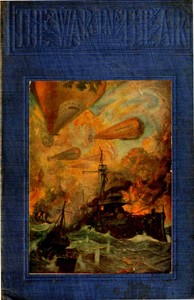
The War in the Air by H. G. Wells

(5 User reviews)   1089
By Charles Murphy Posted on Jan 12, 2026
In Category - Resilience
Wells, H. G. (Herbert George), 1866-1946 Wells, H. G. (Herbert George), 1866-1946
English
Ever wonder what people in 1908 thought the future would look like? H.G. Wells gives us his answer in 'The War in the Air,' and it's a wild ride. Forget tidy sci-fi—this is a messy, chaotic story about a hapless bicycle repairman named Bert Smallways who accidentally gets swept up in the world's first global air war. One minute he's in a runaway balloon, the next he's witnessing fleets of German airships heading to bomb America. It's a book that feels startlingly modern in its prediction of total war from the sky, all seen through the eyes of a completely ordinary guy who just wants to go home. If you like your classics with a big dose of 'what have I gotten myself into,' this is for you.
Share

Read "The War in the Air by H. G. Wells" Online

This book is available in the public domain. Start reading the digital edition below.

START READING FULL BOOK
Instant Access    Mobile Friendly

Book Preview

A short preview of the book’s content is shown below to give you an idea of its style and themes.

The reader should grasp clearly the date at which this book was written. It was done in 1907: it appeared in various magazines as a serial in 1908 and it was published in the Fall of that year. At that time the aeroplane was, for most people, merely a rumour and the “Sausage” held the air. The contemporary reader has all the advantage of ten years' experience since this story was imagined. He can correct his author at a dozen points and estimate the value of these warnings by the standard of a decade of realities. The book is weak on anti-aircraft guns, for example, and still more negligent of submarines. Much, no doubt, will strike the reader as quaint and limited but upon much the writer may not unreasonably plume himself. The interpretation of the German spirit must have read as a caricature in 1908. Was it a caricature? Prince Karl seemed a fantasy then. Reality has since copied Prince Carl with an astonishing faithfulness. Is it too much to hope that some democratic “Bert” may not ultimately get even with his Highness? Our author tells us in this book, as he has told us in others, more especially in The World Set Free, and as he has been telling us this year in his War and the Future, that if mankind goes on with war, the smash-up of civilization is inevitable. It is chaos or the United States of the World for mankind. There is no other choice. Ten years have but added an enormous conviction to the message of this book. It remains essentially right, a pamphlet story--in support of the League to Enforce Peace. K. THE WAR IN THE AIR CHAPTER I. OF PROGRESS AND THE SMALLWAYS FAMILY 1 “This here Progress,” said Mr. Tom Smallways, “it keeps on.” “You'd hardly think it could keep on,” said Mr. Tom Smallways. It was long before the War in the Air began that Mr. Smallways made this remark. He was sitting on the fence at the end of his garden and surveying the great Bun Hill gas-works with an eye that neither praised nor blamed. Above the clustering gasometers three unfamiliar shapes appeared, thin, wallowing bladders that flapped and rolled about, and grew bigger and bigger and rounder and rounder--balloons in course of inflation for the South of England Aero Club's Saturday-afternoon ascent. “They goes up every Saturday,” said his neighbour, Mr. Stringer, the milkman. “It's only yestiday, so to speak, when all London turned out to see a balloon go over, and now every little place in the country has its weekly-outings--uppings, rather. It's been the salvation of them gas companies.” “Larst Satiday I got three barrer-loads of gravel off my petaters,” said Mr. Tom Smallways. “Three barrer-loads! What they dropped as ballase. Some of the plants was broke, and some was buried.” “Ladies, they say, goes up!” “I suppose we got to call 'em ladies,” said Mr. Tom Smallways. “Still, it ain't hardly my idea of a lady--flying about in the air, and throwing gravel at people. It ain't what I been accustomed to consider ladylike, whether or no.” Mr. Stringer nodded his head approvingly, and for a time they continued to regard the swelling bulks with expressions that had changed from indifference to disapproval. Mr. Tom Smallways was a green-grocer by trade and a gardener by disposition; his little wife Jessica saw to the shop, and Heaven had planned him for a peaceful world. Unfortunately Heaven had not planned a peaceful world for him. He lived in a world of obstinate and incessant change, and...

This is a limited preview. Download the book to read the full content.

Published in 1908, H.G. Wells’s The War in the Air feels less like a distant prophecy and more like a warning we’re still trying to heed. It’s a story about the moment technology outruns our humanity, told with Wells’s signature blend of big ideas and small, relatable characters.

The Story

Meet Bert Smallways, a slightly clueless but good-hearted Englishman who runs a bicycle shop. His life is upended when a demonstration balloon breaks loose, carrying him and a volatile inventor across the English Channel. They’re captured by a massive German air fleet—the ‘Drachenflieger’—on its way to launch a surprise attack on the United States. Bert, a mere bystander, becomes an accidental stowaway and witness as this new era of airborne warfare ignites a global conflict. The book follows his desperate, often absurd journey to survive as civilization crumbles below.

Why You Should Read It

What makes this book stick with you isn’t just the airships and explosions (though those are great). It’s Bert. Through his confused, terrified eyes, we see how world-changing events feel to someone with no power. Wells uses him to ask tough questions: What happens to the little guy when nations decide to fight wars in a brand new, terrifying dimension? The book is grimly accurate in predicting how air power would erase the line between soldier and civilian, making everyone a target.

Final Verdict

This isn’t a sleek, action-packed adventure. It’s a thoughtful, sometimes clunky, but deeply human story about vulnerability. It’s perfect for readers who love classic science fiction that focuses on ideas and social commentary, for anyone interested in the roots of the dystopian genre, and for history fans curious about early 20th-century fears. If you enjoy seeing where our modern anxieties about technology and war came from, give Bert Smallways’s misadventure a try.


🟢 Copyright Status

This title is part of the public domain archive. Knowledge should be free and accessible.

Patricia Thompson
4 months ago

Given the topic, the balance between theory and practice is exceptionally well done. I will be reading more from this author.

Patricia Sanchez
3 months ago

My professor recommended this and the material builds progressively without overwhelming the reader. A true masterpiece of its kind.

Andrew Young
1 month ago

I didn’t realize how engaging this would be until the author avoids unnecessary jargon, which is refreshing. This sets a high standard for similar books.

Amanda Carter
2 months ago

Without a doubt, the writing remains engaging even during complex sections. This was both informative and enjoyable.

Carol Flores
3 weeks ago

I’ve been searching for content like this and the character development is subtle yet leaves a lasting impact. I couldn't put it down until the very end.


4
4 out of 5 (5 User reviews )

Add a Review

Your Rating *
There are no comments for this eBook.
You must log in to post a comment.
Log in

Related eBooks