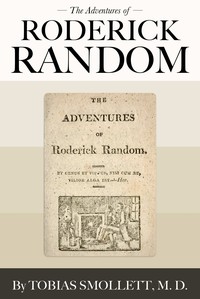
The Adventures of Roderick Random by T. Smollett

(4 User reviews)   1181
By Charles Murphy Posted on Jan 12, 2026
In Category - Resilience
Smollett, T. (Tobias), 1721-1771 Smollett, T. (Tobias), 1721-1771
English
Ever wondered what it was like to be a young man in the 1700s with absolutely zero luck? Meet Roderick Random. His life is one disaster after another—from cruel relatives to con artists, press gangs to perilous sea voyages. This book is a wild, bumpy ride through 18th-century Britain and beyond, following a hero who just can't catch a break. It's funny, brutally honest, and packed with more shady characters than a pirate's tavern. If you like stories where the main character gets kicked around by fate but never gives up, you'll be rooting for Roderick from page one.
Share

Read "The Adventures of Roderick Random by T. Smollett" Online

This book is available in the public domain. Start reading the digital edition below.

START READING FULL BOOK
Instant Access    Mobile Friendly

Book Preview

A short preview of the book’s content is shown below to give you an idea of its style and themes.

memory retains the circumstance, and the heart improves by the example. The attention is not tired with a bare catalogue of characters, but agreeably diverted with all the variety of invention; and the vicissitudes of life appear in their peculiar circumstances, opening an ample field for wit and humour. Romance, no doubt, owes its origin to ignorance, vanity, and superstition. In the dark ages of the World, when a man had rendered himself famous for wisdom or valour, his family and adherents availed themselves of his superior qualities, magnified his virtues, and represented his character and person as sacred and supernatural. The vulgar easily swallowed the bait, implored his protection, and yielded the tribute of homage and praise, even to adoration; his exploits were handed down to posterity with a thousand exaggerations; they were repeated as incitements to virtue; divine honours were paid, and altars erected to his memory, for the encouragement of those who attempted to imitate his example; and hence arose the heathen mythology, which is no other than a collection of extravagant romances. As learning advanced, and genius received cultivation, these stories were embellished with the graces of poetry, that they might the better recommend themselves to the attention; they were sung in public, at festivals, for the instruction and delight of the audience; and rehearsed before battle, as incentives to deeds of glory. Thus tragedy and the epic muse were born, and, in the progress of taste, arrived at perfection. It is no wonder that the ancients could not relish a fable in prose, after they had seen so many remarkable events celebrated in verse by their best poets; we therefore find no romance among them during the era of their excellence, unless the _Cyropædia_ of Xenophon may be so called; and it was not till arts and sciences began to revive after the irruption of the barbarians into Europe, that anything of this kind appeared. But when the minds of men were debauched by the imposition of priestcraft to the most absurd pitch of credulity, the authors of romance arose, and losing sight of probability, filled their performances with the most monstrous hyperboles. If they could not equal the ancient poets in point of genius they were resolved to excel them in fiction, and apply to the wonder, rather than the judgment, of their readers. Accordingly, they brought necromancy to their aid, and instead of supporting the character of their heroes by dignity of sentiment and practice, distinguished them by their bodily strength, activity, and extravagance of behaviour. Although nothing could be more ludicrous and unnatural than the figures they drew, they did not want patrons and admirers; and the world actually began to be infected with the spirit of knight-errantry, when Cervantes, by an inimitable piece of ridicule, reformed the taste of mankind, representing chivalry in the right point of view, and converting romance to purposes far more useful and entertaining, by making it assume the sock, and point out the follies of ordinary life. The same method has been practised by other Spanish and French authors, and by none more successfully than by Monsieur Le Sage, who, in his _Adventures of Gil Blas_, has described the knavery and foibles of life, with infinite humour and sagacity. The following sheets I have modelled on his plan, taking me liberty, however, to differ from him in the execution, where I thought his particular situations were uncommon, extravagant, or peculiar to the country in which the scene is laid. The disgraces of Gil Blas are, for the most part, such as rather excite mirth than compassion;...

This is a limited preview. Download the book to read the full content.

Published in 1748, this is one of the first great English adventure novels. It follows our hero, Roderick Random, a poor Scottish boy with a good heart but terrible fortune. After being cast out by his grandfather, he sets off into the world. What follows is a series of wild misadventures. He gets tricked, robbed, and shanghaied onto a warship. He survives a bloody naval battle, gets stranded in South America, and falls in with all sorts of rogues and a few rare friends. Through it all, Roderick is just trying to find his place, make some money, and maybe win the heart of the lovely Narcissa.

Why You Should Read It

Forget the polished, polite 18th century you might imagine. Smollett shows us the gritty, smelly, and hilarious reality. The characters are fantastic—they leap off the page, full of life and selfish motives. Roderick himself is wonderfully flawed; he's often just as vain and quick-tempered as the people who wrong him. The book doesn't preach. It just shows life as a chaotic, often unfair scramble. You laugh at the absurdity even as you feel for Roderick's constant struggles.

Final Verdict

Perfect for readers who love historical fiction with teeth and a big dose of humor. If you enjoyed the satirical edge of Gulliver's Travels or the sprawling journey of Tom Jones, this is your next read. It’s a long, satisfying escape into a world that’s both foreign and strangely familiar in its human folly. Just be ready for some old-fashioned language and a hero who takes his lumps!


ℹ️ Public Domain Content

This historical work is free of copyright protections. It is available for public use and education.

Carol Thomas
1 month ago

Given the topic, the plot twists are genuinely surprising without feeling cheap or forced. An excellent read overall.

Aiden Walker
2 weeks ago

Having explored similar works, the narrative structure is incredibly compelling and well-thought-out. Truly inspiring.

Sandra Jackson
2 weeks ago

This was recommended to me by a colleague and the presentation feels refined and carefully planned. It exceeded all my expectations.

Liam Hernandez
2 months ago

Once I started reading, the diagrams and footnotes included in this version are very helpful. I will be reading more from this author.

4.5
4.5 out of 5 (4 User reviews )

Add a Review

Your Rating *
There are no comments for this eBook.
You must log in to post a comment.
Log in

Related eBooks